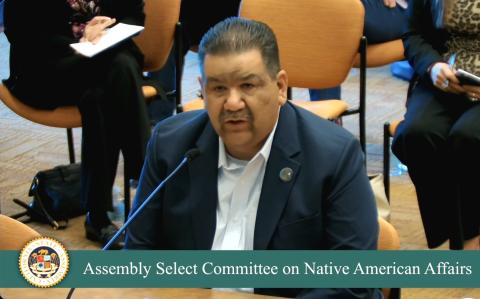

Soboba Band of Luiseño Indians Chairman Isaiah Vivanco was among those who testified before the State Assembly Select Committee on Native American Affairs on March. 13. The hearing, held at the Barona Band of Mission Indians’ reservation, focused on the subject of insurance affordability. Assemblymember James C. Ramos, Chairman of the Select Committee on Native American Affairs, invited three panels to discuss the disproportionate premiums insurance companies charge to homeowners who live on Tribal lands.
The second panel consisted of Barona’s Chairman Raymond Welch, Chairman Vivanco, Chairwoman Erica M. Pinto of the Jamul Indian Village of California, Barona Fire Chief Ken Kremensky and Pechanga Fire Chief Jason Keeling.
“We stand here in the shadow of the 2003 fires that burned 90% of our reservation including 39 homes,” Welch said. “Our history on this 8,000-acre reservation is one of endurance but today that endurance is being tested by an insurance crisis that threatens our financial sovereignty for those of us living in high-risk areas. We now face a fire of a different kind—an economic one. This land is our past and our future. We continue to use our traditional knowledge and modern technology to keep us safe and we will fight to ensure that insurance costs never force a single member to leave their home.”
Vivanco said that through partnerships and the establishment of the Soboba Fire Department, the Soboba reservation’s public protection classification has gone from 3 to 2, which should mitigate the cost of insurance as it helps protect against fires in the area.
The ISO Public Protection Classification (PPC) in California rates fire department effectiveness on a 1-10 scale (1 best, 10 worst) based on dispatch, staffing, water supply, and community risk reduction. Lower scores usually yield lower insurance premiums but that has not been reflected for homeowners living on the Soboba Reservation.
“Our Tribe has been fortunate enough to purchase a bulldozer to create our own fire breaks; we go out yearly and take on that task with our fire department and Public Works crew,” Vivanco said. “We look to this committee and the state for support in helping our endeavors in achieving affordable home insurance so we can continue to build new homes on the lands that we are, I would say, forced to live on.”
As Ramos pointed out in his opening statement, the lands that Tribal communities sit on were not chosen. “Historic state and federal policies forced Indian people to live in the most secluded and rural areas of California,” he said.
“We embrace those lands because they are our communities,” Vivanco said. “We have done the work to create and maintain a safe environment to make sure that our homeowners can go out and hopefully achieve affordable insurance to protect their homes and their resources and yet we are still not seeing that.”
He would like to see the insurance providers visit the reservation and talk to the fire and Public Works departments to see the efforts that have been made to mitigate the risk of fire. “I look forward to further discussions where hopefully we can come to some type of resolution where the state and the Tribes can all be on the same page, working with insurance companies to ensure we have the ability to obtain insurance as it was meant to be,” Vivanco said.
Chairwoman Pinto voiced her concern that as the cost of insurance premiums rise, it strains Tribal budgets and can deter investment in critical infrastructure. “Insurance insecurity also translates to broader social and cultural consequences,” she said. “Home ownership and Tribal community housing are essential to Tribal sovereignty as Tribal housing can anchor cultural continuity, ensure intergenerational knowledge transfer and engender a stable family life. When insurance becomes prohibitively expensive or unavailable, Tribal members may be forced to seek housing outside our communities, undermining efforts to revitalize our Tribal homeland and traditions. Tribal cultural sites, ceremonial spaces and ancestral landscapes require protection that extends beyond simple rebuilding costs.”
Mitigation efforts were outlined by the two fire chiefs that were present. Ramos introduced the third panel members, State Insurance Commissioner Ricardo Lara and Seren Taylor, who serves as Vice President for the Personal Insurance Federation of California. Lara discussed some of the legislation that is being presented that will hopefully resolve many of the issues brought to light at the hearing. He also suggested more meetings to discuss ongoing problems that Tribes are having with securing affordable insurance.
Vivanco said Soboba was rated in the top 2,000 of the 40,000 communities that were included in the latest PPC report. “We’ve always been taught to be good stewards of our lands that we have and that is part of it, making sure that we can mitigate the risk of fires to protect our reservation at the same time,” he said. He is hoping the insurance companies can appreciate the extra efforts they make and offer quality insurance at a decent rate. “I think that’s what we’re not getting and it’s frustrating because Tribes put in a lot of resources to these efforts,” Vivanco said. “Tribes are doing what’s right and always will.”
Ramos was in total agreement and said the point that was being established is that Tribal governments use their own assets to protect their homes against fires and natural disasters and the mitigation efforts they take on are benefiting the surrounding communities as well. Yet Tribal governments are not given credit for spending their own assets to help mitigate more than just their own lands. Instead, they are penalized with high insurance premiums.
“The purpose of this committee is to gain understanding and make sure California’s First Peoples are included in the equation when we take information back to the state legislature,” Ramos said.
To view the hearing in its entirety, please visit: https://www.assembly.ca.gov/media/assembly-select-committee-native-ameri....